Artificial Intelligence A hands-on handbook that takes you from the mathematics underneath to transformers, robots and models on a phone. Every topic is explained in plain prose, built from scratch in Python and checked against the libraries used in practice.
12 parts
36 topics ready
114 topics planned
215 runnable examples
Twelve parts, one path
Start with the core, then branch out by interest.
Foundations The mathematics and classic algorithms every later part leans on: vectors and matrices, probability, derivatives and optimization, information theory and search.
5 of 5 topics ready Machine learning Classical supervised and unsupervised learning, built from scratch and then checked against scikit-learn.
13 of 13 topics ready Data at scale What changes when data no longer fits on one machine: the MapReduce model, distributed storage and compute, link analysis, pattern mining and recommendation.
2 of 7 topics ready Neural networks From a single perceptron to a trained multilayer network, with backpropagation derived in full and then computed by hand and by code until the two agree.
7 of 7 topics ready Signal processing How sound and images become numbers, how those numbers are cleaned up and compressed, and which of these ideas machine learning still relies on.
1 of 7 topics ready Computer vision Classical image processing and geometry first, then convolutional networks and object detection, so the learned methods are seen against what they replaced.
2 of 15 topics ready Natural language processing Language before transformers: text processing, statistical language models, classic classifiers, word representations and recurrent sequence models.
0 of 10 topics ready Transformers and large language models Attention computed by hand, a small GPT trained from scratch, and the techniques that turn a pretrained model into a useful system: decoding, fine-tuning, preference tuning, retrieval and efficient inference.
3 of 12 topics ready Reinforcement learning Learning from rewards: Markov decision processes, tabular Q-learning worked by hand, deep Q-networks and learning to navigate.
2 of 5 topics ready Robotics Mobile robots end to end: middleware, kinematics, sensing, localization, mapping and navigation.
1 of 12 topics ready Edge AI Running models where the data is produced: microcontrollers, gateways and phones.
0 of 17 topics ready Responsible AI Privacy, fairness, accountability and honest reporting, with code where code helps: re-identification risk, federated learning and measured rather than claimed results.
0 of 4 topics ready Inside every topic
Every topic has the same shape, so once you know one you can find your way around all of them.
Readable theory Plain prose, with formulas and diagrams drawn as images. From-scratch code A package of small modules, one idea per file, fully commented. Runnable examples Short scripts, each showing one idea or one library comparison. A sample project An end-to-end command line project on a realistic task. A guided notebook A tour that imports the package and shows results inline. Tests Checks for every worked example and every property the page claims.
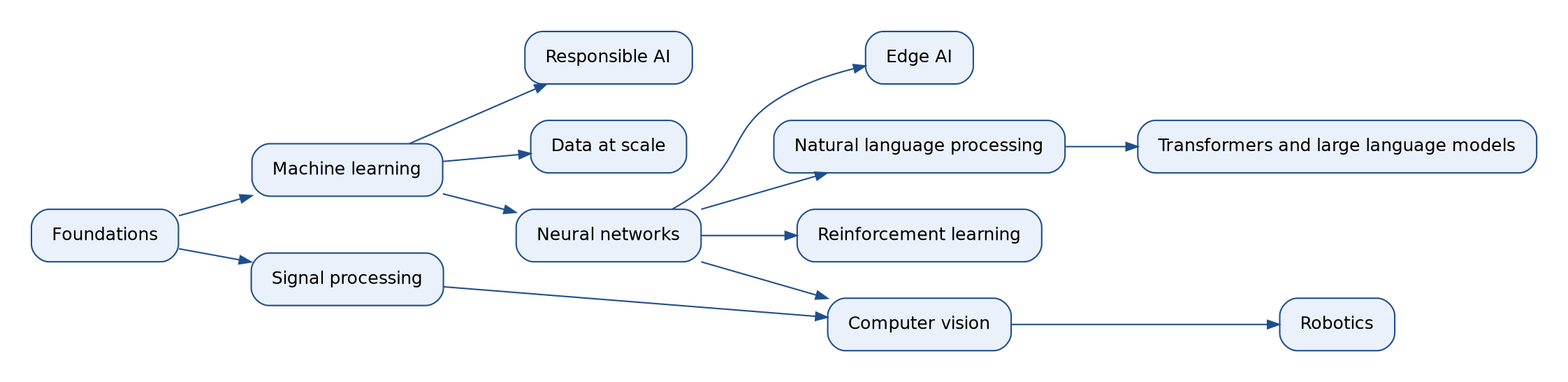
Learning path
Start with the core and branch out by interest. Each part lists what it builds on.
Getting started
You need Python 3.11 or newer. The repository installs as one package, so every example and project script can import the topic it belongs to. Dependencies are grouped by subject in pyproject.toml, and each topic names the groups it needs near the top of its README.
With uv:
uv sync --group dev --group ml --group deep
uv run python neural-networks/backpropagation/examples/worked_step.py
uv run pytest
With pip 25.1 or newer:
python -m venv .venv
source .venv/bin/activate
pip install -e . --group dev --group ml
pip install torch --index-url https://download.pytorch.org/whl/cpu
python neural-networks/backpropagation/examples/worked_step.py
pytest